The new office and growing team will support the OpenFlexure Project and the charity’s mission to expand access to essential technologies through open-source design and local manufacturing.
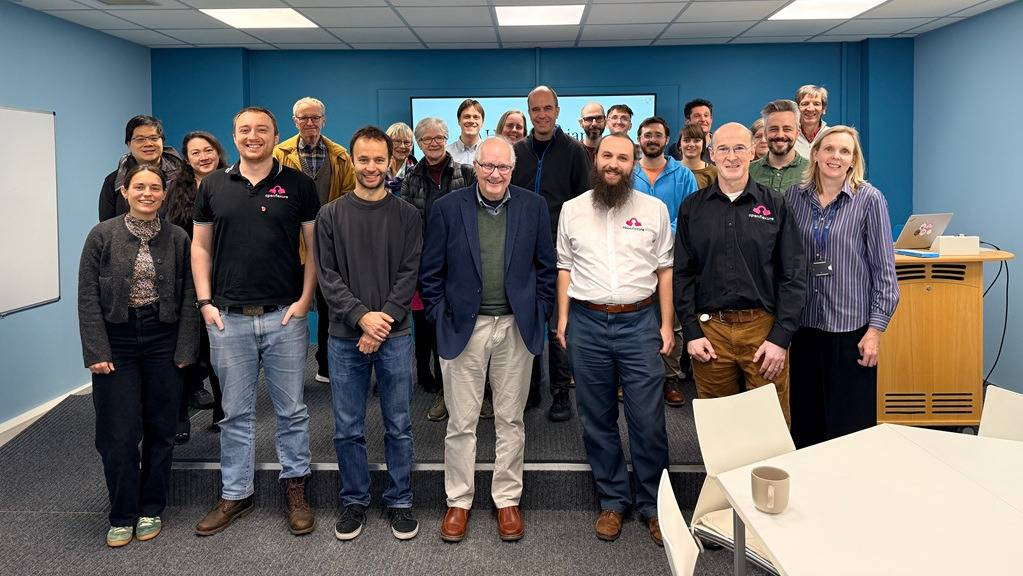 Attendees at the office launch. (Photo credit Lydia Green)
The Humanitarian Technology Trust has opened its new office in Bath, marking a significant step in the charity’s work to make essential technologies more accessible through open-source design and local manufacturing.
Founded in 2025, the Humanitarian Technology Trust develops and supports open-source designs for essential technologies that can be manufactured, maintained and adapted locally. By enabling communities to build and support the tools they need, the charity seeks to reduce reliance on expensive equipment and fragile supply chains that can make essential technologies inaccessible.
The charity’s first project is the OpenFlexure Microscope, an open-source digital microscope designed to make high-quality imaging more affordable and accessible. Through the OpenFlexure Project, the Trust supports the microscope’s development and deployment, alongside the skills and local capabilities needed to manufacture, maintain and use it. Microscopy is essential for scientific and medical research, diagnostics and education, yet access to modern automated microscopy remains limited in many parts of the world.
Established by researchers and engineers associated with the University of Bath, the University of Glasgow, and the OpenFlexure Project, the Humanitarian Technology Trust was founded to take promising technologies beyond the laboratory and make them available to the people and organisations that need them.
“Universities are fantastic at creating technologies that could transform millions of lives. But taking a technology to market usually means focusing on the customers who can generate a return for investors, rather than the people who could benefit from it most. To truly benefit those with the greatest needs, we need to develop technologies that can be manufactured and maintained locally. However, this rarely offers the kind of financial return that attracts commercial investment,” says Dr Julian Stirling, Chief Executive of the Humanitarian Technology Trust. “We founded the Trust to help bridge that gap. We continue developing these technologies with fully open and accessible designs, empowering businesses anywhere on Earth to produce them for the benefit of their local communities.” The opening follows a grant of 800,000 USDC (a digital currency designed to maintain a value equivalent to one US dollar) from the Balvi Philanthropic Fund, created by Ethereum co-founder Vitalik Buterin. The funding supports an 18-month programme focused on advancing the OpenFlexure Project, developing the technology and supporting its wider deployment.
The programme is helping build the technical capacity needed to develop OpenFlexure and support its adoption by manufacturers and organisations in different settings, building on the project’s open-source foundations and international partnerships.
“This funding marks a significant step forward for the Humanitarian Technology Trust, giving us the capacity to accelerate the development of OpenFlexure and support its adoption around the world. Over the next 18 months, we can strengthen the technical foundations of the project, grow the partnerships and expertise needed to support local manufacturing, and lay the groundwork for the next stage of its development,” continues Dr Stirling.
The new Bath office provides a dedicated base for the Humanitarian Technology Trust’s growing team, supporting the continued development of OpenFlexure and its deployment around the world.
The OpenFlexure Microscope has been used in at least 75 countries across every continent, including Antarctica. The next phase of the project will build on this foundation through continued technology development and support for local partners in countries such as Brazil and Kenya to develop their own capacity to manufacture diagnostic microscopes.
The OpenFlexure Project demonstrates how open-source design can make essential technologies more accessible by enabling equipment to be manufactured, maintained and adapted locally. This approach underpins the Humanitarian Technology Trust’s wider mission to make essential technologies available to the communities and organisations that need them.